What to Put in a Teacher Toolbox (Drawer by Drawer)
Updated · Written to our editorial standards
A teacher toolbox is the small multi-drawer organizer — usually a hardware or craft storage unit with rows of clear plastic drawers — that sits on the corner of a teacher's desk and holds the little things a lesson stalls without: sticky notes, binder clips, a dry-erase marker that actually works. Its whole value is that every item has one labelled place, so you, a substitute, or a student helper can find it in seconds without opening three bins and a desk drawer.
This guide goes drawer by drawer, then covers the paper drawers most lists forget, labelling, restocking on a teacher's budget, and the one piece of desk technology teachers ask about most. If you were looking for i-Ready's Teacher Toolbox, that is something else: Curriculum Associates' digital collection of K–8 teaching resources, which has nothing to do with drawers.
Choosing the organizer
Any small-parts cabinet works, and the right one is mostly a matter of fit. Four things are worth checking before you buy or repurpose one:
- Drawers deep enough for a box of staples and a roll of tape, the two bulkiest small items.
- Clear or translucent fronts, so a half-empty drawer is obvious before the lesson that needs it.
- A footprint that leaves the desk usable. A toolbox that crowds out the space where you mark papers does not survive the first month.
- A unit that stays put when a drawer is pulled with one hand, which is how it will be opened mid-lesson.
Fewer, fuller drawers beat many near-empty ones. If you cannot think of what would go in a drawer, you do not need it yet.
A drawer-by-drawer list
Every classroom differs, but most toolboxes settle on a version of this list. The reason column is the useful part: if a drawer has no reason in your room, give the space to something that does.
| Drawer | What goes in it | Why it earns the space |
|---|---|---|
| Sticky notes | Two sizes, plus page flags | Exit tickets, quick notes home, marking a page |
| Clips | Binder clips and paper clips | Holding a set of papers together without a stapler |
| Board supplies | Dry-erase markers and magnets | A dead marker mid-lesson is the classic stall |
| Loaner pencils | Sharpened pencils and cap erasers | For the student who arrives without one |
| Highlighters | Three or four colours | Marking texts, colour-coding feedback |
| Glue and tape | Glue sticks and a tape roll | Notebook inserts and torn pages |
| Staples | A box of staples and a remover | The stapler always runs out at the worst time |
| Scissors | One small pair, kept separate from student scissors | Trimming cards and cutting out sheets |
| Labels and cards | Address labels and index cards | Name tags, flashcards, quick signs |
| Game pieces | Dice and a sand timer | Instant maths games and timed tasks |
| First aid | Adhesive bandages, if your school allows them | Many schools send every injury to the nurse, so check first |
The paper drawers: spare sheets and early finishers
The drawers most lists leave out hold paper, and they are the ones that save a lesson. Keep a small stack of lined paper for the child who has filled their notebook, and a few sheets of graph paper for lining up columns in maths. Both print free from the lined paper generator and the graph paper generator at exact ruled spacings, so a spare sheet matches what the class is already using.
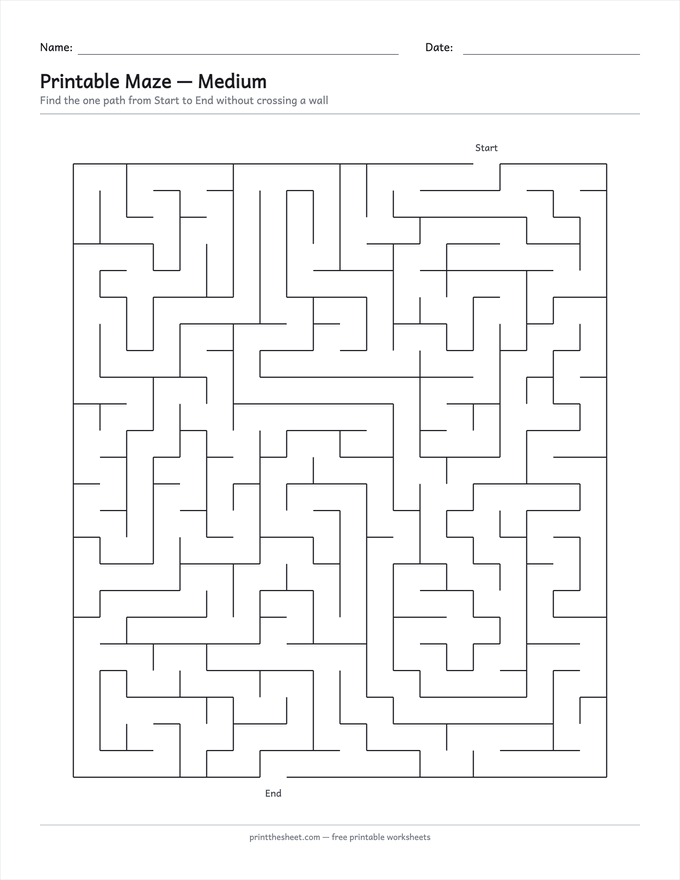
The second paper drawer is for early finishers: a handful of independent puzzles that need no explanation, so a student who finishes first has something worthwhile to do while you help the others. A maze from the printable mazes generator or a puzzle from the printable sudoku maker fits the bill, and the stack refills in a minute.
A third, thinner drawer pays off on the day you are out: a printed calendar page for the month from the printable calendar with key dates marked, plus a class list and the daily schedule, so a substitute can find the essentials without searching your desk.
Labels and the five-minute reset
Label every drawer on the front, in words a student would use: "clips", not "fasteners". Large print matters more than pretty print; the label has to be readable from a step away. Once a drawer has a label, it holds only that thing.
A toolbox drifts toward junk drawer within weeks unless it gets a regular reset. Five minutes at the end of each week is enough: empty anything that has wandered into the wrong drawer, note what is running low, and throw out dried markers. Many teachers make this a student job, which also teaches the class where everything lives.
Decide early who may open the toolbox. Some teachers keep it teacher-only; others let students take a loaner pencil or a sticky note without asking, which saves a dozen interruptions a day but means the reset has to happen weekly without fail. Either rule works, as long as the class knows which one applies. Whatever you choose, put the toolbox where the drawers you use mid-lesson are within reach of where you teach, not tucked behind the computer.
Restocking on a teacher's budget
Teachers in many schools pay for some of these supplies themselves, so it is worth trying the free routes first: the school supply cupboard, the start-of-year supply list sent home, and families who are glad to send in a box of tissues or markers when asked for something specific. Keep a running list taped inside the top drawer of what ran out and when; after one term it tells you what to buy in bulk at the back-to-school sales, and which drawer you never actually opened.
In the United States, the IRS educator expense deduction can recover part of the rest. According to IRS Topic 458 (page last reviewed 24 September 2026), an eligible educator — a K–12 teacher, instructor, counsellor, principal or aide working at least 900 hours in a school year — can deduct up to $300 of unreimbursed expenses, or $600 for a married couple filing jointly when both are eligible educators (no more than $300 each). Qualified expenses include books, supplies, equipment and supplementary materials used in the classroom. Check the figures for the year you file; this is not tax advice. Either way, keep receipts in an envelope in the bottom drawer, because a deduction you cannot document is one you cannot claim.
Beside the toolbox: is a document camera worth it?
A document camera is a camera on an adjustable arm that shows a page or object live on a projector or screen. It has replaced the overhead projector in many classrooms, and unlike most overhead projectors it usually works in a fully lit room. Its everyday uses are simple and frequent: modelling handwriting on the same worksheet the class has, showing how to set out a maths method step by step, and sharing a student's work, with their permission, so the class can learn from it.
Before buying one, check whether your school already has one in a cupboard; many do. If you are choosing, five things matter more than any feature list:
- The arm reaches high enough to capture a whole US Letter or A4 page.
- It connects the way your room is set up: through a computer, or straight to the projector.
- The image is sharp enough to read worksheet text from the back row.
- The base is steady enough that writing on the page does not shake the picture.
- It folds away small enough to live beside the toolbox.
For a trial before spending anything, a phone on a stand, joined to a video call or mirrored to the classroom screen, does a rough version of the same job.
Frequently asked questions
What is a teacher toolbox?
A small multi-drawer organizer on a teacher's desk that keeps everyday supplies — sticky notes, clips, markers, spare pencils — in labelled drawers, so anyone can find them in seconds.
What should I put in a teacher toolbox?
Start with the supplies that stall a lesson when they are missing: sticky notes, clips, dry-erase markers, loaner pencils, glue, tape, staples and scissors. Add a drawer of spare lined and graph paper and a stack of early-finisher puzzles.
How should I label a teacher toolbox?
Label the front of each drawer in large print, using the word a student would use. Keep one kind of item per drawer, and reset it for five minutes once a week.
Can teachers deduct the cost of classroom supplies?
In the United States, IRS Topic 458 (reviewed 24 September 2026) lets eligible K–12 educators deduct up to $300 of unreimbursed classroom expenses, or $600 for a married couple filing jointly when both qualify. Check the current rules for the year you file.
Do teachers need a document camera?
Not every teacher, but it is the gadget teachers use most for modelling work on the same page students have. Check whether your school already owns one, and try a phone on a stand first if you are unsure.
Is this the same as i-Ready's Teacher Toolbox?
No. i-Ready's Teacher Toolbox is Curriculum Associates' digital collection of K–8 teaching resources. This guide is about the desk organizer of the same name.